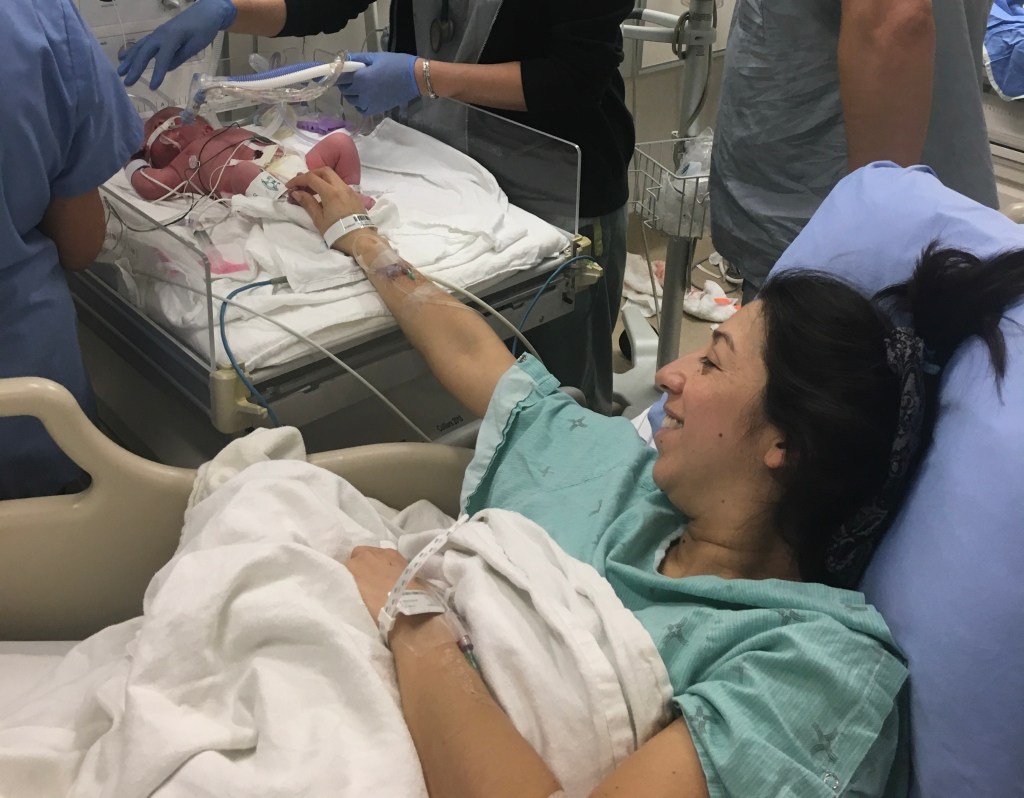
Samuel suffered a massive brain injury at the time of his birth which ultimately affected nearly every part of his brain.  His story is a common one, affecting hundreds of kids across Canada every year.  While not all such birth injuries are preventable, Samuel's was, at least in part.  When we arrived at the hospital, he had a low heart rate. The Niagara Health System, in order to save a few dollars, has opted not to ALWAYS have an anesthesiologist available in case an emergency C-Section is needed. Yet every second counts in such circumstances. Samuel had to wait while the hospital called an anesthesiologist to come in from his home.  By the time the C-section finally took place, most of the damage was done.  His heart had gone from a slow to zero, completely starving what had been a perfectly healthy brain of oxygen. He had to be removed from the OR and resuscitated. The only hope for a recovery is to slow the brain injury.  This is done using something called hypothermic cooling.  Our local hospital lacks this technology, so we had to wait for a portable unit to arrive from a city an hour away.  We were assured that as long as the cooling was begun within six hours, it would help.  This immediately struck me as naive.  If the brain injury was a cascading event, it was obvious that earlier would be better.  The health care workers clearly did not understand the concept of six hours being a cut-off for any benefit, as opposed to being sufficient for maximal benefit.  So, Samuel was
Further He was placed under a heat lamp instead of immediately receiving passive cooling as protocol demanded.  The full cooling didn't happen for 4-5 hours after birth, when the sooner it is started the better.  Doctors kept citing a 6-hour rule, assuming that 6 hours was a magical timeline as opposed to a gradient response, where earlier is better.
Hope for Kids Like Samuel
Documenting our run for Prevention | Therapy | Research
Samuel’s Birth
Recent posts
Quote of the week
“blahdidadidah.”
~ Ron Thomson
 Hope for Kids Like Samuel